
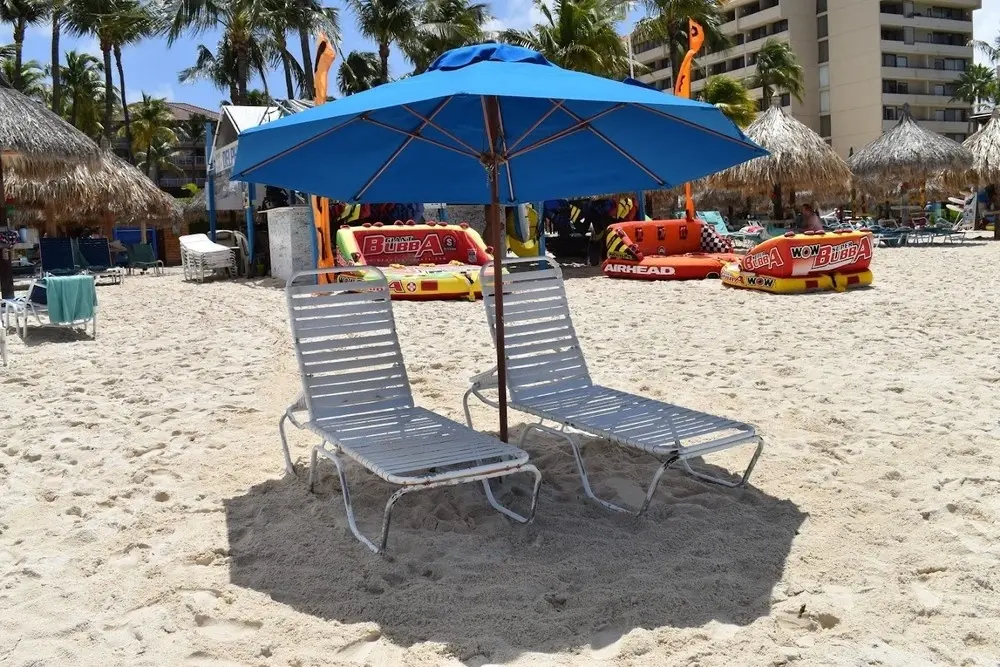
Check availability & book your umbrellaReserve online. Umbrella and 2 chairs, set up for you.
Aruba is about 12 degrees north of the equator, so the midday sun is close to overhead all year and the UV index sits in the very high to extreme range most days. The constant trade wind keeps you cool while you burn. Between about 10 AM and 3 PM you want real shade, not a hat and hope.
Visitors from North America and Europe consistently underestimate the Aruba sun, and it is not their fault: the breeze makes 31 degrees feel pleasant, the water is cool, and nothing warns you until the evening. Here is what is actually happening and how to plan around it.
Why the sun is stronger here
Latitude. Aruba sits around 12.5 degrees north, well inside the tropics. The sun passes close to directly overhead, the light travels through less atmosphere, and there is very little seasonal variation. A December midday in Aruba is far stronger than a June midday in most of the United States or Europe. Add white sand and bright water reflecting light back up at you, and shade from above covers only part of the exposure.
The UV index, in plain terms
Forecasts for Aruba routinely show a UV index in the very high to extreme range in the middle of the day, for most of the year. At those levels, unprotected skin that burns in 20 or 30 minutes at home will burn in a fraction of that time. The sensible rule here is the simple one: seek shade during the middle of the day, cover up, and reapply sunscreen after every swim.
The wind is the trap
Aruba's trade winds average 12 to 16 knots and blow all day, gusting higher in the afternoons. They are the reason the island is comfortable at all, and they are also the reason people burn so badly: the wind evaporates sweat and keeps skin feeling cool, so the body's usual warning never arrives. By the time you feel hot, you are hours past the point where you should have moved under cover.
The hours that matter
Roughly 10 AM to 3 PM is the window to be under shade, with the peak around noon to 2 PM. Early morning and late afternoon are kinder, and sunset on the west coast beaches is the best hour of the day. This is why a beach day here is built around shade in the middle rather than a towel on open sand: our sets stand from 10 AM to 4 PM precisely because that is when you need them.
What counts as shade
A palapa or an umbrella, planted and staying put. A hat is not shade; it protects your scalp and nothing else. A beach tent is shade until the wind takes it. A towel is not shade at all. If you rely on reflected light being harmless, the sand and the water will prove you wrong by dinner.
One wind-anchored umbrella and two chairs on Eagle Beach or Palm Beach, 10 AM to 4 PM, reserved in your name. $100 a day plus 20% tax and fees, $120.00 all in.
Sunscreen, and what Aruba asks of you
Use a broad-spectrum sunscreen with a high factor and put it on before you reach the beach, then again after every swim. Aruba has moved to restrict sunscreens containing oxybenzone to protect its reefs, so bring a reef-safe product; the island's shops stock them. Sunglasses matter more than people think, because the glare off the water is constant.
Children and first days
Children burn faster and complain later. Keep them under the umbrella for the middle of the day, in rash vests in the water, and in the pool or indoors for part of the afternoon on day one. Your own first day deserves the same caution: the worst burns we see are from the first afternoon, when people arrive from the airport and go straight to the sand at 2 PM.
Read next
- A full beach day in Aruba, hour by hour
- Will your beach umbrella survive the Aruba wind?
- Palapa or beach umbrella: the difference
Be under shade when it counts
Umbrella and two chairs reserved in your name, 10 AM to 4 PM.
Check dates and bookCheck availability & book your umbrellaReserve online. Umbrella and 2 chairs, set up for you.
Palapa Aruba is our main beach shade service at Eagle Beach and Palm Beach. See palapaaruba.com.