
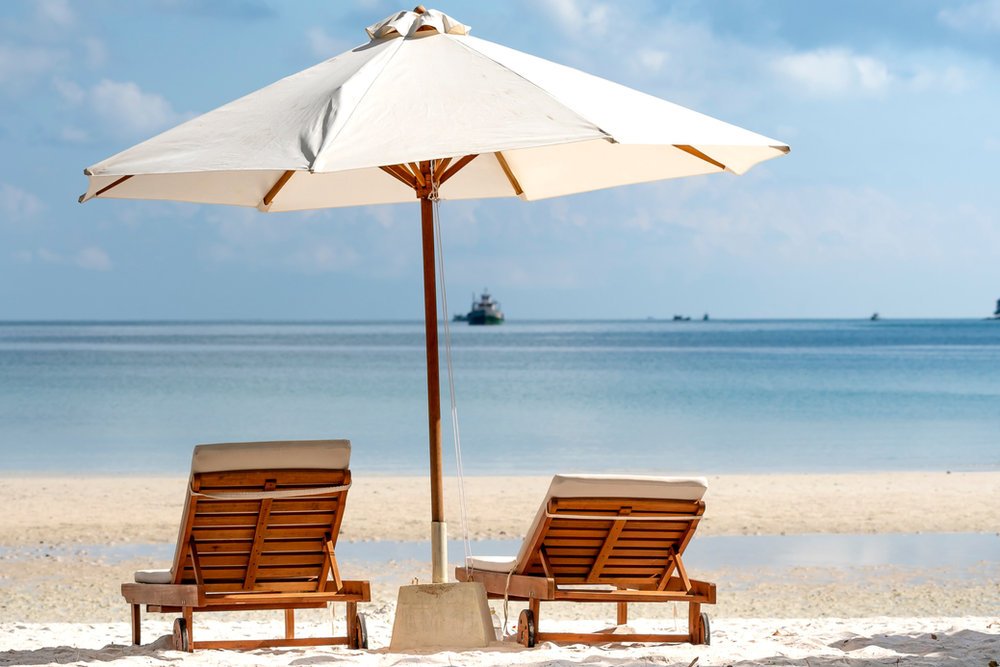
You can bring one, and plenty of people do. What the cheaper price does not cover is the bag, the daily carry, the spot you still have to find, planting it in sand that will not hold, and watching it all day.
Short answer: yes, you can. The longer answer is that most people who try it end up wishing they had not, and it is worth knowing why before you give up a third of your suitcase to a beach umbrella.
Will it even fit in your luggage?
A beach umbrella that is any use in Aruba has a pole around six feet long. Folded down it is still well over a metre. That does not go in a carry-on, and in a checked bag it eats the space you wanted for everything else. Some airlines will take it as an odd-sized item, some will charge for it, and it arrives bent often enough that it is worth asking yourself what happens if it does.
Buying one when you land
The supermarkets near Palm Beach sell beach umbrellas for roughly $25 to $40. On paper that beats renting. In practice you are buying the cheapest category of umbrella there is and taking it straight to one of the windiest beaches in the Caribbean.
Eagle Beach averages 12 to 16 knots of trade wind through the year, and a $30 umbrella is not built for a steady 15-knot breeze. If it survives the week you then have the second problem: it will not fit in your suitcase on the way home either, so it gets left behind, which is how beaches end up with bins full of broken umbrellas every season.
The part nobody mentions: planting it
Dry sand does not hold a pole. You need to get down to damp sand, work the pole in deep, and keep checking it as the surface dries around it. Do that badly and the umbrella lifts out at head height with a gust behind it. Do it properly and you have spent twenty minutes of your beach day digging.
What you are really choosing between
- Bring your own: suitcase space, a bent pole, twenty minutes of digging, and somebody keeping an eye on it all day.
- Buy one there: $25 to $40, built for calm weather, probably abandoned at the end of the week.
- Rent a set that is already standing: nothing to carry, nothing to plant, nothing to leave behind.
How the rental works
Our sets are put up before you arrive and anchored for the wind that day. One umbrella and two chairs, standing at the spot under your name from 10:00 AM until 4:00 PM — you can swim, eat somewhere, leave the beach and come back, and the set is still yours. It is $100 a day plus 16% tax, so $116 for the set rather than per person.
There are two beaches to choose from, Eagle Beach and Palm Beach, and eight sets on each per day. Check the dates you want — if you are booking 48 hours or more ahead you pay and it is confirmed straight away.
Count the real cost before you decide
Bringing or buying your own looks cheaper on paper, and on paper it usually is. The costs that do not show up on the receipt are the ones worth counting.
There is the checked bag you would not otherwise have paid for, or the trip to a shop on your first morning instead of the beach. There is the walk down and back every single day with an awkward two-metre object plus everything else you are carrying. There is the spot you do not have, so you are still hunting for somewhere to sit in the same crowd as everybody else. And at the end of the week there is an umbrella you cannot take home, which means either leaving it behind or repacking it.
None of that makes bringing your own wrong. It just means the comparison is not "$116 versus $30" — it is a booked, standing, anchored set versus a week of small jobs you do yourself in the sun.

You become the person watching an umbrella
This is the part that surprises people. The trade winds on this coast average roughly 6 to 8 metres per second, about 12 to 16 knots, and they do not drop off during the day. March and May through August are the windiest months; October to December are the calmest and still breezy.
An umbrella you planted yourself in that wind needs checking. The sand around the pole loosens as people walk past, and the hour you stop paying attention is the hour it goes. So you sit there half-watching it, or you come back from a swim to find it flat and somebody else's towel underneath it. That is not the day anyone flew here for.
It is also a genuine hazard. A loose umbrella crosses a crowded beach fast, pole first, and Aruba's beaches are full of people who did not sign up for that.
And the sun does not wait for you to sort it out
Aruba sits about twelve degrees north of the equator. UV readings in Oranjestad commonly run 10 to 14, peak around March and April, and stay extreme from roughly 11:00 AM to 2:00 PM, when unprotected fair skin can begin to burn in under ten minutes. Whatever shade you arrange, it has to be standing and holding through exactly those hours.
What renting from us replaces
Every job in the list above disappears, which is the only honest way to describe what you are paying for. You do not pack an umbrella, buy one, carry one, plant one, guard one or get rid of one at the end of the week.
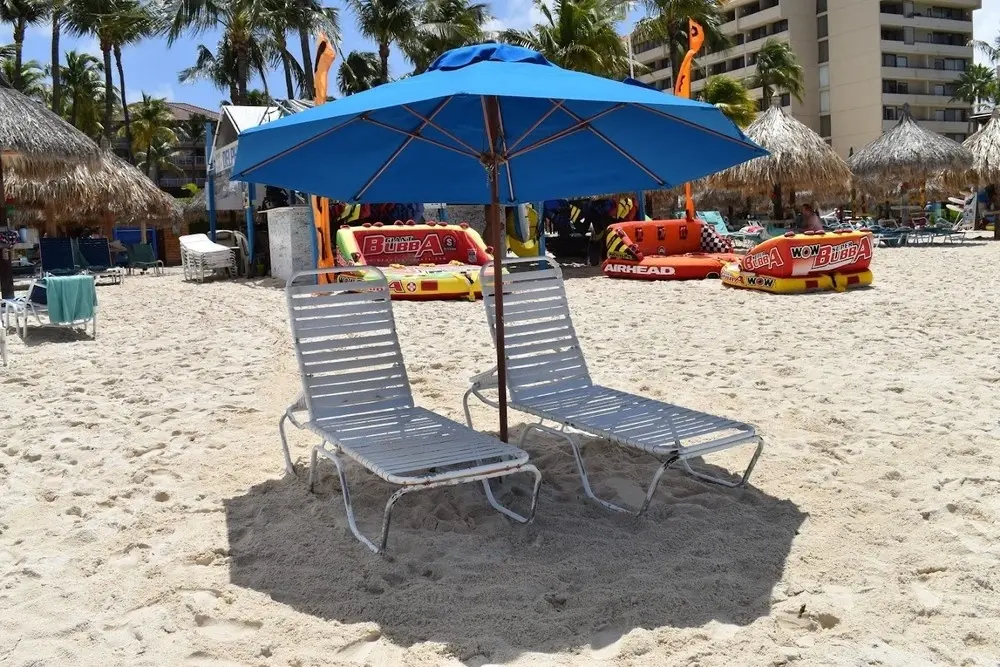
Your umbrella and two beach chairs are standing at the spot when you walk up, already anchored for the wind by a crew who set them in this sand every day, reserved under your name. Nothing is delivered to your hotel and nothing is handed to you. From 10:00 AM to 4:00 PM the spot is held for the full day, so leaving for a swim or a long lunch costs you nothing — it is still yours when you come back.
We are on Eagle Beach and Palm Beach, eight sets per beach per day. That is a genuine ceiling rather than a scarcity line, and in high season the good days go.
$100 a day plus 16% tax — $116.00, on Eagle Beach or Palm Beach, yours 10:00 AM to 4:00 PM. Eight sets per beach per day.
What it costs, and when to book it
$100 a day for the set, plus 16% tax — $116.00 in total, with nothing added for delivery or setup. If your beach day is at least 48 hours away, paying online confirms it immediately. If it is sooner, the beach has to be checked against walk-ins first, so you send a request without paying and a secure payment link follows by email once a set is confirmed free. The meeting point is emailed after the booking is settled, not published here.
The short version: bring your own if you enjoy the project. Book a set if you would rather spend the week on the beach than managing one.
Travel lighter
Leave the umbrella at home — yours is already on the sand when you get there.
Check your datesRead next
Will your beach umbrella survive the Aruba wind? — the actual wind figures, month by month.
If you are hoping to get one of the free palapas instead, the team on our sister site has written up how the free palapas in Aruba really work.