

Aruba’s trade winds average 12 to 16 knots and blow all day. An umbrella pushed into dry sand by hand will lift — what keeps one standing is how deep it is set, a vented canopy, and somebody checking it after the first hour.
Aruba is one of the windiest islands in the Caribbean, and that single fact decides whether your beach umbrella stays where you put it or ends up cartwheeling down the sand while you chase it.
How windy does it actually get?
At Eagle Beach the average wind speed runs between 6 and 8 metres per second through the year, which is roughly 12 to 16 knots, or about 13 to 18 miles per hour. That is the average, not the gusts. The windiest stretch is March and then May through August. The calmest months are October, November and December, and even then the average sits at 12 knots.
For context, 15 knots is enough to lift an unanchored beach umbrella clean out of dry sand. Most holiday umbrellas are designed for a quiet afternoon in a sheltered bay, not for a constant trade wind coming off open water.
Why the trade winds never really stop
The wind in Aruba is not weather that passes. The island sits in the path of the north-east trade winds, which blow more or less continuously across the Caribbean. It is the reason the divi-divi trees all lean the same way, the reason the island is a windsurfing destination, and the reason your umbrella needs more than a hopeful twist into the sand.
What actually happens to a self-planted umbrella
- It holds for twenty minutes while the sand is damp, then works loose as the surface dries.
- A gust catches the canopy from underneath and the whole thing becomes a sail.
- The pole comes out of the sand pointed end first, at head height, travelling fast.
- Someone in your group spends the day holding it down instead of swimming.
That last one is the most common outcome, and the least talked about. A beach umbrella that needs a human anchor is not shade, it is a chore.
How ours are set
Our sets are put up by the beach crew before you arrive and anchored for the wind that is actually blowing that day. You do not carry anything, you do not plant anything, and nobody in your group has to sit holding a pole. The umbrella and two chairs are standing at the spot under your name from 10:00 AM, and they stay yours until 4:00 PM, so you can swim, go for lunch, leave the beach and come back to the same set.
An Aruba umbrella rental is $100 a day plus 16% tax, which is $116 for the set, not per person. There are eight sets on each beach, so the day can and does sell out.
Which months to worry about most
If you are travelling between March and August, assume wind. That is the stretch when the averages sit at the top of the range and when self-planted umbrellas fail most often. October through December is gentler, but 12 knots will still take an umbrella that has not been anchored properly.
Either way the answer is the same: the set is already standing when you get there, and holding it down is not your job.

What "wind resistant" actually means on this beach
Plenty of beach umbrellas are sold as wind resistant. On Aruba that phrase has to mean something specific, because the wind here is not a gust that arrives and passes — it is a steady load on the canopy for six hours straight.
Three things decide whether an umbrella holds. How deep the pole goes, and into what: dry surface sand gives almost nothing, and the sand that holds is further down and damper. How the canopy is shaped, because a vented canopy lets pressure out of the top instead of turning the whole thing into a sail. And whether anyone checks it after the first hour, once the sand around the pole has been walked on and worked loose.
A visitor planting an umbrella for the first time gets none of those right, and there is no reason they should. It is a skill you pick up by doing it every day on the same beach, in the same sand, in the same wind.
The part that is a safety issue, not a comfort issue
An umbrella that lets go does not fall over politely. It lifts, turns, and travels across the sand with a metal pole leading. On a busy stretch of Palm Beach in February there are children, sunbeds and people asleep between you and wherever it is going.
This is the honest reason we do not sell you gear and send you off with it. A rental that hands over an umbrella has transferred the problem to someone who has never dealt with it. We would rather put it in ourselves.
Shade is not optional here either
Aruba sits about twelve degrees north of the equator. UV readings in Oranjestad regularly reach 10 to 14, peak around March and April, and sit in the extreme band from roughly 11:00 AM to 2:00 PM — the window in which unprotected fair skin can start to burn in under ten minutes.
So an umbrella that spends the middle of the day lying on its side is not an inconvenience. It is the difference between a good week and three days of hiding indoors.
What you actually book
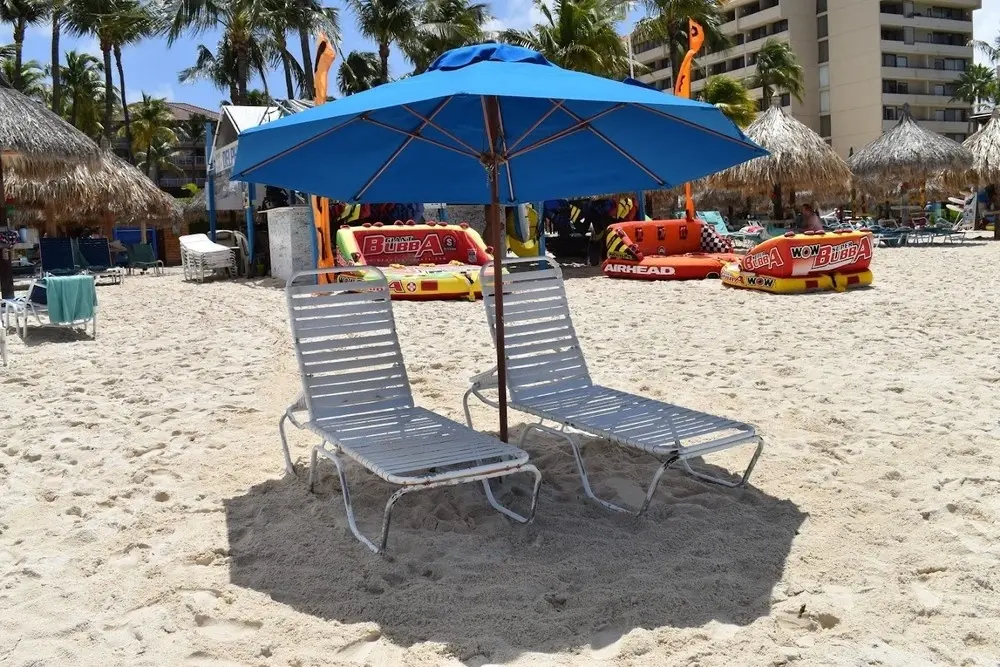
Nothing is delivered to your hotel, and there is nothing for you to carry down to the sand. Your umbrella and two beach chairs are already standing at the spot, set up and anchored for the wind, under your name, before you arrive. You walk up and sit down.
The set is yours from 10:00 AM to 4:00 PM and it is held for the whole day, not for as long as you stay in it. Swim, go for lunch, disappear for two hours in the worst of the heat, come back at three — it is still there, still anchored, still yours.
We work two beaches, Eagle Beach and Palm Beach, with eight sets per beach per day. That is the real number of spots we can put up and keep an eye on, which is also why days do sell out in high season.
$100 a day plus 16% tax — $116.00. Eight sets per beach per day on Eagle Beach and Palm Beach, yours 10:00 AM to 4:00 PM.
Price, and how far ahead to book
One set — umbrella plus two beach chairs — is $100 for the day plus 16% tax, so $116.00 per day. No delivery fee, because nothing is delivered. No setup fee, because the setup is the service.
A beach day 48 hours or more away is confirmed the moment you pay online. Anything closer than that has to be checked against walk-ins on the beach first, so you send a request without paying, we confirm a set is genuinely free, and a secure payment link comes back by email. Either way the exact meeting point is emailed to you once the booking is settled rather than published on the site.
If the weather makes the beach unusable and the set cannot go up, the booking moves to another day or is refunded. Wind alone does not do that — the whole point is that our umbrellas stay up in it.
Let someone else fight the wind
Your umbrella goes in anchored, by people who set them in this sand every day.
Check your datesRead next
Can you bring your own beach umbrella to Aruba? — what it costs to buy one locally, and whether it fits in a suitcase.
Wind figures: average monthly wind speed at Eagle Beach.